
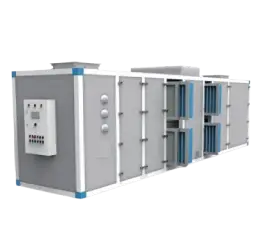
Application Of Fresh Air Chemical Filtration Unit
The fresh air chemical filtration unit is mainly used for the front end of outdoor fresh air treatment in the control room. It can handle polluted outdoor air. After passing through various levels of physical and chemical filtration of the unit, it can ensure that the air entering the room meets G1 or G2 standards.
The following is a typical configuration diagram of a fresh air chemical filtration unit, including the G4 initial efficiency filtration section, 2nd level chemical filtration section, F7 intermediate efficiency filtration section, fan section, and control system. The entire unit is designed to be modular, and all filters can be replaced as a whole.
Chemical filtration materials Modular filter material M9000 & M9000C : Material has efficient removal effect on corrosive gases such as H2S, SO2, and CL2.
Chemical filtration materials Modular filter materialM1000 & M1000C : Material has efficient removal effect on corrosive gases such as H2S, SO2, and NOX.
Stages and Construction can be customised based on request:
Interlocking Control Technology Description:
Interlocking with air valves/airtight valves:
The unit can be interlocked and controlled with the built-in electric air valve or the air valve/airtight valve installed on the pipeline. When the unit receives a fire alarm or toxic and harmful gas alarm signal to close, the valve should be closed at the same time. When the alarm signal disappears, the valve should be opened when the unit is started.
Interlocking with the fan:
The unit can be interlocked and controlled with the fan installed on the pipeline. When the unit receives an alarm signal to shut down the unit, the fan can be stopped at the same time. When the alarm signal disappears, the unit can be started and the fan can be started at the same time.
Interlocking with toxic and harmful gas probes:
The unit can monitor the concentration of flammable, toxic and harmful gases in real time, and shut down the unit upon receiving an alarm signal. At the same time, it can also close valves, fans and other related equipment, and provide feedback signals to the DCS system.
Interlocking with DCS system:
The control system is equipped with a DCS interface, which can transmit equipment operation, stop, and fault signals to the centralized system in the control room. In addition, it can also receive fire alarms, harmful gas alarms, and other signals from the DCS system and provide feedback on shutdown signals to the DCS system.